Showing posts with label bordeaux. Show all posts

Thursday, 11 September 2014

Château Monconseil-Gazin

Following on from my last blog about the Côtes de Bourg this time I will be taking a more in depth look at an individual winemaker from the nearby Côtes de Blaye. Château Monconseil Gazin is owned by Jean-Michel Baudet and his wife Francoise. Jean-Michel is the 5th generation of his family making wine at the Château.

I should say there is a little bit of self interest here. My parents-in-law Rob and Norma, who are big wine lovers, have been enjoying wine from the Monconseil Gazin estate for some years. Their original knowledge of this particular vineyard came about via an unusual present that Norma bought Rob for a birthday.  The birthday presented entitled Rob to own a row of vines for a year at the estate. Mainly a bit of a fun yes, but it has led to them returning to the vineyard and buying the wines every year since.


3D Wines offers an alternative way to
support local vineyards
The gift came from 3D Wines Experience, a well established company offering an opportunity for anyone to support small, family run vineyards. The business was started in 1992 and now offers opportunities to support vineyards in many wine producing areas including most of the main regions of France including Bordeaux, and also vineyards in Tuscany and New Zealand. I believe the opportunity to 'own' vines for a year may have been discontinued but the business is still successful. And it must be working for Château Monconseil Gazin as they are still in the scheme

As with the Côtes de Bourg the Côtes de Blaye is one of the lesser known appellations of Bordeaux producing more simple wines but still with 6600 hectares under vine. Merlot is king, with some Cabernet Sauvignon and Malbec also produced. Most wines produced here are blends of the three. The majority of the operations are family affairs and I saw this at first hand on my visit to the Château Monconseil Gazin in July. It was built in around 1500 and soon became an important country seat. Since 1894 five generations of the Baudet family have been making wine although wine has been produced here for many more centuries. It was only in the 1950s that the Gazin parcel of land was added and the Château took the name it is known by today.  The family are celebrating 120 years of history over the weekend of the 20th and 21st September this year.

Touring the cellars
5 fantastic wines are made at Monconseil Gazin
Francoise discussing wines with Rob, Norma & myself
Our visit was unscheduled which was a bit naughty of us (They would prefer you to ring or email ahead if you wish to visit) but Rob and Norma know Francoise so well that there was no problem and soon we were touring the winery and tasting the wines. Five wines are made on the estate and we tried them all. A classic red (Francoise refers to this as the Saturday wine), a grand reserve red (the Sunday wine), a classic white (100% Sauvignon Blanc), a prestige white (Sauv Blanc with 20% Semillon) and finally a rather delicious Rosé that I immediately purchased a case of to bring home. I should add that all the wines were fab and I could have happily drunk the 'Sunday' red every day of the week.
But more important than the details of the wines, Francoise was a fantastic host, speaking perfect English and welcoming us with bundles of enthusiasm for her wines. This is the lovely thing about the wine industry in France. Yes, some of it is very corporate and big business like but much of it isn't. It's about families who are so proud of their produce and they just enjoy sharing that love with you.
As we were leaving we popped our heads into the winery itself and saw Francoise's daughter helping to label the bottles. Francoise  told us she was more interested in horses than wine at the moment but hopefully that will change. I hope so too. So lovely to see a family business being handed from generation to generation. 
If you are ever in France, or indeed in any other wine producing area do go and visit the local vineyard. I am pretty certain you will get a very warm welcome. 

Me with Francoise 


A memento of our visit


Do you enjoy my wine blogs? Come and meet me in person. Visit my website www.gloryofwine.com or follow my Facebook or Twitter feeds. I would love to organise a tasting event for you.


Until next time. Enjoy your wine.
Cheers!

Simon


Friday, 29 August 2014

Côtes de Bourg

Have you heard of the Côtes de Bourg? Well of course you should have if you read my previous blog! Joking aside unless you are a Bordeaux wine aficionado or have maybe visited the area I doubt it. In fact the Côtes de Bourg is one of the 54 appellations of Bordeaux and possibly one of it's least well known.

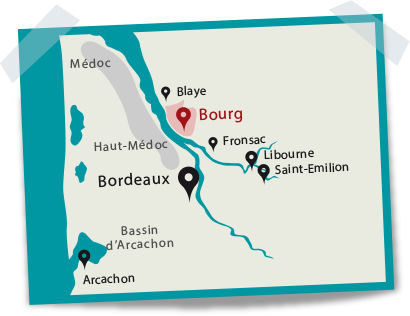
It is situated 35 km (22 miles) to the north of Bordeaux on the 'right bank'. In this case right bank means to the east of the Gironde estuary, whereas 'left bank' means to the west. This is actually an important distinction because due to the soil and climate, or 'terroir' as the French like to call it the 'right bank' tends to be Merlot dominated and the 'left' Cabernet Sauvignon.

Trans-Gironde ferry to the Medoc
I holidayed in the area in July and was absolutely fascinated by the wine production there and it's neighbouring appellation the Côtes de Blaye. This area is certainly not one of the glamour parts of the region like the Haut-Medoc or St Emilion. More a workaday region producing wines mostly drunk locally and by the tourists that pass by. The towns of Blaye and Bourg are lovely places to stay and if you want to go and visit the more prestigious wine places St Emilion is just over an hour away by car (We did) and the Haut-Medoc even closer if you catch the Trans-Gironde ferry (We also did) which departs right from the centre of Blaye.

The Côtes de Bourg styles itself 'The Spicy Side of Bordeaux'. Not entirely sure how true that is, after all we are talking mostly Merlot here not spicy Syrah. However the wines do have a slightly more tannic bite.

But it is the scale of production that I want to get across to you. When driving around the area the vineyards seem to go for mile after mile after mile (sorry kilometer, we are in France after all). The total area under vine is just under 4000 hectares producing. The famous Napa Valley of California has only 17,000 hectares of vines and Marlborough in New Zealand 22,000. Not that small then for a region you've never heard of and the wines virtually never come to the UK or much beyond French borders. 85% is sold in France.

Mere statistics do not tell the whole story though. Wine is such a way of life in France that when visiting a wine producing area you cannot escape the seductiveness of it. We visited the small town of Bourg, took lunch, and then visited the Maison du Vin. Most towns in the area have these. These, literally, 'houses of wine' showcase all of the local wines and very often beautifully presented.

 And finally we come to the best thing of all, the wines are so reasonable to buy. Of 134 wines available 91 were under 10 (£8 or $13) many around 6. And remember these 134 wines come from an area that is small outpost of the whole Bordeaux wine spectrum.

Maison du Vin - Bourg


 The following photos were all taken inside the 'Maison du Vin- Bourg'


As you can see from the photographs the Maison was beautiful inside and a pleasure just to wander around admiring the bottles. I should say it was also nice and cool inside on a scorching hot day! More information about the Côtes de Bourg can be found at the tourism website www.cotes-de-bourg.com.

Next time I shall be recalling my visit to the Chateau Monconseil-Gazin vineyard in the nearby Côtes de Blaye.

Do you enjoy my wine blogs? Come and meet me in person. Visit my website www.gloryofwine.com or follow my Facebook or Twitter feeds. I would love to organise a tasting event for you.

Until next time. Enjoy your wine.
Cheers!
Simon

Friday, 8 August 2014

Bordeaux

I know what you're thinking. Well actually possibly two things. Either, Bordeaux, French wine, Claret, wine of boring old farts and rich bankers or possibly Bordeaux, blimey, big topic for one blog.
Bordeaux - Beautiful city
And home to the greatest wine region in the world


Well, it certainly is a big topic, one that has had thousands of books written about it and I could not possibly do it justice in one of my short blogs. As you may be aware I visited Bordeaux for a holiday last month and this is intended as the first of a series of blog on my time in the region.

Bigger isn't always better - New Zealand wine sales have soared
Bordeaux as a wine producing region is vast, so vast in fact that the amount of wine produced here would rank 10th in the world if Bordeaux was as a country. It produces 675 million litres of wine a year (That is 900 million bottles!). That is 3 times the amount that New Zealand produces.

The comparison with New Zealand is rather apt because 'Kiwi' wine has become very popular in Britain just as sales of French wine have declined in recent years. According to latest Nielsen data 1 in every 5 bottles over £7 is from New Zealand. 


But it wasn't always like that. Bordeaux and England have a long association going back to the 12th century when Eleanor of Aquitaine married Henry Plantagenet, the future King Henry II. Bordeaux was in the control of the British for almost 300 years and it was during the time of Richard the Lionheart, son of Henry and Eleanor that drinking the wines of Bordeaux really took off. Between the end of the Hundred Years War in 1453 and the First World War (1914-1918) Bordeaux boomed and much of the wine was exported to Britain as well as the low countries. The Dutch had a major influence as its engineers drained the marshy and swampy Medoc left bank home of the most famous wine names of the region today.

The classification of the wines was started in 1855. You will often hear me refer to '1855 and all that...' It's a flippant remark and the subject actually deserves a blog all on it's own. Typing 1855 classification into Google gets you over 12 million results. It's actually one of the first things you learn about at wine school, Bordeaux usually being the first region to be covered.

The classification of AOCs (often ACs) or Appellation d'Origine Controlée started in the 1930s and
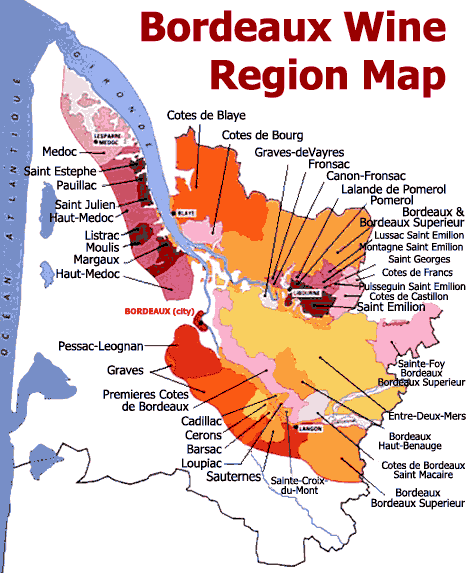
Bordeaux wine map - All 54 appellations of it
continues to be occasionally modified today. The literal translation is 'controlled designation of origin' and it ensures that to be labelled with a particular are the wine must be made in a certain way with regard to the grape types, maturation period and type of maturation for example.

These stiff rules have become restrictive to the winemakers leading to wine from the new world such as Australia, Chile and the aforementioned New Zealand where there are less restrictions on experimentation becoming popular at the expense of classic Bordeaux 'Claret'.

Just the phrase 'Claret' itself is a British invention. It derives from the French word 'clairet' meaning dark rosé which was the typical style of wine exported to Britain during the 12th - 15th centuries. It is a protected word but I prefer not to use it and you will never see it used on a label.

What you will see is a bewildering array of information including the appellation the wine is from, (See the map opposite) but never the actual grape variety which I am sure is one of the principal reasons why the new world has usurped France and Bordeaux in sales.

I spent most of my week in on holiday in the Cotes de Blaye and Cotes de Bourg. I would guess most of you reading this will not of heard of those areas. It is true that they are not the most well known of the Bordeaux appellations but to actual see the rolling vineyards going on for mile after mile is an awe inspiring sight. In my next blog I will tell you a little more about the Cotes de Bourg.

Enjoying the blog. Why not meet me in person. Visit my website www.gloryofwine.com or follow my Facebook or twitter feeds. I would love to organise a tasting event for you.

Until next time, enjoy your wine.
Cheers!
Simon

Tuesday, 10 June 2014

The Judgement of Paris

Never heard of it. No, me neither until relatively recently. Is it a book, a film or a major political happening in France? It's none of those, well actually that is not strictly true as it is a film and a book (written after the event), but a film of a different name.

The Judgement of Paris - May 1976
It is one of the most important happenings in the modern world of wine. On the 24th May 1976 wine merchant, now Consultant Editor of Decanter magazine, Steven Spurrier, organised in Paris, a blind tasting where French judges scored the best and most prestigious Bordeaux red wines and Burgundy Chardonnay against Cabernet Sauvignons and Chardonnays from California.

Steven Spurrier (centre) in 1976 
Steven Spurrier - Today
The results stunned the judges and sent a seismic shock through the wine world and can be seen as year zero in terms of new world regions competing with the traditional old wine regions, in particularly the classic French regions.


Prior to that time the French had the monopoly on 'fine' wines and that reputation went around the world. Serious wine drinkers drank Bordeaux or Claret, as we British used to call it, and Burgundy.To take advantage of the USA's bicentennial celebrations Spurrier, then only 34 and running a wine school in Paris, decided to organise a blind tasting with the great and the good of the French wine world to do the judging. To this day, he thinks that he had rigged it for the French to win. But they didn't and the wine world changed forever.

Chateau Montelena 1973 - 1st place Chardonnay
The eleven judges, nine of them French plus Spurrier and Patricia Gallagher (American) of L'Acadamie de Vin tasted the whites first, four Burgundies and six Chardonnay from California. The judges scored the wines out of 20 and the scores were averaged. Amazingly California wines occupied four of the top 6 places including the prestigious 1st place going to the Chateau Montelena.

1.Chateau Montelena 1973   USA
2.Meursault Charmes Roulot 1973  France
3.Chalone Vineyard 1974  USA
4.Spring Mountain Vineyard 1973  USA
5.Beaune Clos des Mouches Joseph Drouhin 1973  France
6.Freemark Abbey Winery 1972  USA
7.Batard-Montrachet Ramonet-Prudhon 1973  France
8.Puligny-Montrachet Les Pucelles Domaine Leflaive 1972  France
9.Veedercrest Vineyards 1972  USA
10.David Bruce Winery 1973  USA

Stag's Leap 1973 - 1st place red
After the whites came the all important reds, seen as more important. Spurrier knew that Chateau Montelena had won the white tasting and was so desperate for the French to win on the reds he even told the judges so they could mark accordingly. Four Grand Cru Bordeaux against six Californian Cabernets. Despite blatant marking down of the wines that the judges definitely thought were Californian amazingly the USA won again with Stag's Leap Wine Cellars 1973 coming out on top.

1.Stag's Leap Wine Cellars 1973  USA
2.Château Mouton-Rothschild 1970  France
3.Château Montrose 1970  France
4.Château Haut-Brion 1970  France
5.Ridge Vineyards Monte Bello 1971  USA 
6.Château Leoville Las Cases 1971  France
7.Heitz Wine Cellars Martha's Vineyard 1970  USA
8.Clos Du Val Winery 1972  USA
9.Mayacamas Vineyards 1971  USA
10.Freemark Abbey Winery 1969  USA

On hearing the results the French wine industry was horrified and Spurrier was shunned in French wine circles for a time for the damage he had done to their industry. 

The story of the event may not have become so well known had it not been for George Taber, the sole journalist that attended the event who wrote a four paragraph piece for Time magazine. When news of the event reached back to California the effect was electrifying. Where once it made only cheap 'jug' wines now many new people were ready to invest, in particular in Napa Valley which has become the most prestigious of all Californias' wine regions. 

The tourist trade has followed with visits to wineries becoming an important part of the tourism landscape of California. Reruns of 'The Judgement of Paris' have occurred repeatedly since 1976 with the USA wines continuing to win on a regular basis. And the Californian wine industry goes from strength to strength thanks to films like Sideways and the film that tells the story of that day Bottle Shock

But I think there is a lesson here for English wines too. Our English Sparkling Wine has done very well in competitions in the last few years, competing very well against Champagnes. What we need next is a momentous event such as 'The Judgement of Paris'. Over the next few years wine tourism in England and Wales is going to become a big but a little booster such as 'The Judgement of Paris' would be very nice indeed.

That is all for now. I will return with another blog soon. Thanks for reading. If you would like to meet me in person and home is in the UK why not book an event with me. More information can be found at my website www.gloryofwine.com. Maybe you need an excuse for a party involving some lovely wines. Or you might like to come to one of my events. Do get in touch.

You can also follow me on twitter or on facebook

 Enjoy your wine. Cheers!

Simon


Friday, 8 March 2013

Birmingham School of Wine

If you are at all interested in wine the only way to really learn more is to actually taste more. Obviously most of us have got limited funds for buying wine so an enjoyable way of getting to taste a variety of wines is by going to a wine tasting.

I am in a privileged position of working in the hospitality trade and wine tastings are something I go to on a reasonably regular basis and it is great fun, providing you can leave the car at home and remember which pocket you put your house keys in when you get home.


But there are plenty of opportunities for the general public to get involved too, and it doesn't have to cost you a fortune. One such company that offers this opportunity near me is Birmingham Wine School which was established in 2008 and offers a wide variety of courses for everyone from people simply interested in wine up to professional people in the trade like myself who wish to gain professional qualifications in the subject.

My father-in-law Rob is very passionate about his wine, especially Bordeaux and he would admit to being a proper Francophile. He loves going there and enjoying the French way of life, especially the 'vin'. So for his birthday his wife, my mother-in-law bought for him (and me - thank you Norma) tickets for 'Good Food would choose Bordeaux' which took place at the The Old Joint Stock, a lovely old Fullers pub that does great ales and food in central Birmingham on Tuesday 19th February.

My somewhat wine spattered tasting notes from the evening


I will confess at this point that we both knew what to expect, as the previous year we had attended the same venue for The Grand Tour of France which was a whistle stop tour of the whole of France.

We ate before we arrived, therefore not repeating the mistake made last time when I for one fell asleep on the train home. It's amazing how those little sips add up and by the end of the night you can easily have drunk nearly a whole bottle. They do actually put on some cheese, paté and biscuits for you and with some wines, food as an accompaniment is a real help to enjoying the wine.

We started with a Sauvignon Blanc from Entre-deux-Mers exactly as I had predicted to Rob. But for most, including me, and leaving aside for a moment the fantastic sweet wine from Sauternes and the like, Bordeaux is all about red wine, 'Claret' as we British used to love to call it. The first red was actually a bit of an anti-climax, a decidedly dull but inoffensive Bordeaux Superieur that came from Tesco (surprise, surprise). Actually it probably would have gone well with one of those dodgy lasagnes.

You get a little A4 sheet with a bit of information about each of the wines before you start the night, region, grape variety, year, merchant etc along with a short description but they don't tell you the price of the wines until the end of the night. Therefore myself and Rob have a little competition to see who can get closest at guessing. On this night we decided the loser would have to buy the other a decent bottle as a prize. More of which later. After each wine is poured a general discussion will take place about it's characteristics including the appearance, nose and finally the palate.

La Dominique St Emilion Grand Cru Classé
and Chateau Greysac from Medoc
both 9/10 wines for us
The Tesco wine was £4.99 (I guessed £6.50) and I could see the couple sitting opposite us who were new to this looking a little nervous as if they feared the evening might be a waste of money. The good news was the quality of the wines soon ramped up and after trying pretty good Premieres Côtes de Bordeaux from Château Tanesse and Château Paret from the Côtes de Castillon we tried two really fantastic wines, La Dominique 2003, a St Emilion Grand Cru Classé with fantastic blackcurrant flavours and great balance, and Château Greysac 2003 a Cabernet Sauvignon from the Medoc which was dry but with sweet cherry fruit and soft tannins.

After three more fine wines from Margaux, Montagne de St Emilions and St Emilion  itself we returned to Tesco with a tasting of their finest Sauternes. Now, I know sweet wine isn't to everyones taste, indeed Rob declined an opportunity to try it, but for me it is a delicious honeyed treat to be sampled when ever you get the chance. Shame we didn't have any sticky toffee pudding to go with it.

At the end of the night which was about 90 minutes long our guide, whose name I'm afraid I forgot to write down went through the prices and my competitive nature went into overdrive. Sadly I lost to Rob by 5 wines to 4 with one tied and how he loved that. Now I have to find him a decent bottle. I understand Tesco do some good wine. Seriously though it was an excellent evening and great value. If you have a chance to go please do as I am sure you will enjoy it.

Next time. Two up and coming varieties beginning with V. Verdelho and Viognier. Oh, and roast chicken.

Enjoy your wine. Cheers!

Simon

Follow me on twitter