Showing posts with label New Zealand wine. Show all posts

Friday, 8 August 2014

Bordeaux

I know what you're thinking. Well actually possibly two things. Either, Bordeaux, French wine, Claret, wine of boring old farts and rich bankers or possibly Bordeaux, blimey, big topic for one blog.
Bordeaux - Beautiful city
And home to the greatest wine region in the world


Well, it certainly is a big topic, one that has had thousands of books written about it and I could not possibly do it justice in one of my short blogs. As you may be aware I visited Bordeaux for a holiday last month and this is intended as the first of a series of blog on my time in the region.

Bigger isn't always better - New Zealand wine sales have soared
Bordeaux as a wine producing region is vast, so vast in fact that the amount of wine produced here would rank 10th in the world if Bordeaux was as a country. It produces 675 million litres of wine a year (That is 900 million bottles!). That is 3 times the amount that New Zealand produces.

The comparison with New Zealand is rather apt because 'Kiwi' wine has become very popular in Britain just as sales of French wine have declined in recent years. According to latest Nielsen data 1 in every 5 bottles over £7 is from New Zealand. 


But it wasn't always like that. Bordeaux and England have a long association going back to the 12th century when Eleanor of Aquitaine married Henry Plantagenet, the future King Henry II. Bordeaux was in the control of the British for almost 300 years and it was during the time of Richard the Lionheart, son of Henry and Eleanor that drinking the wines of Bordeaux really took off. Between the end of the Hundred Years War in 1453 and the First World War (1914-1918) Bordeaux boomed and much of the wine was exported to Britain as well as the low countries. The Dutch had a major influence as its engineers drained the marshy and swampy Medoc left bank home of the most famous wine names of the region today.

The classification of the wines was started in 1855. You will often hear me refer to '1855 and all that...' It's a flippant remark and the subject actually deserves a blog all on it's own. Typing 1855 classification into Google gets you over 12 million results. It's actually one of the first things you learn about at wine school, Bordeaux usually being the first region to be covered.

The classification of AOCs (often ACs) or Appellation d'Origine Controlée started in the 1930s and
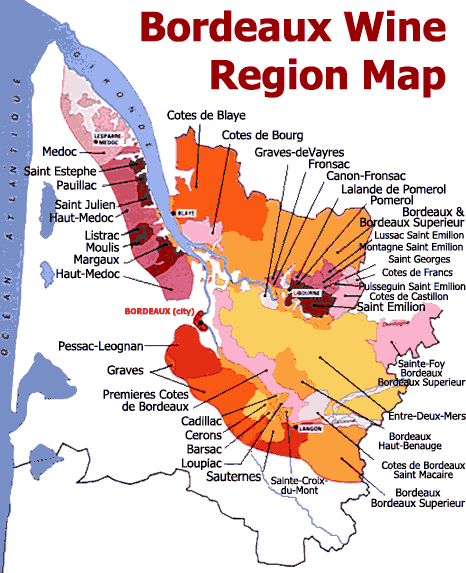
Bordeaux wine map - All 54 appellations of it
continues to be occasionally modified today. The literal translation is 'controlled designation of origin' and it ensures that to be labelled with a particular are the wine must be made in a certain way with regard to the grape types, maturation period and type of maturation for example.

These stiff rules have become restrictive to the winemakers leading to wine from the new world such as Australia, Chile and the aforementioned New Zealand where there are less restrictions on experimentation becoming popular at the expense of classic Bordeaux 'Claret'.

Just the phrase 'Claret' itself is a British invention. It derives from the French word 'clairet' meaning dark rosé which was the typical style of wine exported to Britain during the 12th - 15th centuries. It is a protected word but I prefer not to use it and you will never see it used on a label.

What you will see is a bewildering array of information including the appellation the wine is from, (See the map opposite) but never the actual grape variety which I am sure is one of the principal reasons why the new world has usurped France and Bordeaux in sales.

I spent most of my week in on holiday in the Cotes de Blaye and Cotes de Bourg. I would guess most of you reading this will not of heard of those areas. It is true that they are not the most well known of the Bordeaux appellations but to actual see the rolling vineyards going on for mile after mile is an awe inspiring sight. In my next blog I will tell you a little more about the Cotes de Bourg.

Enjoying the blog. Why not meet me in person. Visit my website www.gloryofwine.com or follow my Facebook or twitter feeds. I would love to organise a tasting event for you.

Until next time, enjoy your wine.
Cheers!
Simon

Tuesday, 28 May 2013

What's in a Name? - New World versus Old

Firstly some housekeeping. I flagged up at the end of my last blog that I would be writing about my local vineyard next. Unfortunately I have not yet had chance to do the tour of the place with the owners and I would like to wait until I have done that before I write about it even though I know it well. Hopefully next time.

On Day 1 at wine school the first thing you learn is about how, historically, winemakers name their wines. Well actually, that is not quite true. The first thing you learn is that white wine is not made from white grapes and red wine is not made from red grapes and that rosé is definitely not made by mixing red wine and white wine together.

What I mean is that old world wines from France, Italy and Spain most prominently name their wines based on place rather than the type of grape variety. This is why we get Rioja, Chianti and Beaujolais instead of Tempranillo, Sangiovese and Gamay. In the new world winemakers make the name of the grape variety pre-eminent so we talk about the Chardonnay of Australia, Chenin Blanc of South Africa or Pinot Noir of New Zealand.

It's not an exact science but it is a good rule of thumb. I say this because there are some new world wine areas that are increasingly synonymous with a particular style of wine. Perhaps the best example these days would be Marlborough 'Sauvignon' from New Zealand.

Australian Burgundy anyone?
In fact if we go back some 25 years plus it was common place for the new world producers to use French names on their bottles so we had Australian Burgundy or Chablis for example. Even in Europe this practice existed to a certain extent. Spanish Cava (which I have to say is a fabulous way to start an evening) was commonly called Spanish Champagne, I suspect primarily to encourage British consumers to buy when in the Costas on the early package holidays of the 1960s and 70s.

Of course this practice no longer exists due to the European Law Protected Geographical Status regulations which protects the status of many local specialties including many British ones including Melton Mowbray Pork Pies and Stilton cheese. See, Europe is not all bad.

For Australian wines the process took a little longer and only on 1st September 2010 did the practice become illegal although in reality Australian winemakers has stopped using French names when their wine became all the rage in the 1980s.

Over the last 20 years in the time that I have worked in the hospitality trade the knowledge of the general public about wine has increased about 100 fold. These days virtually anyone who drinks wine will know what grape varieties they like to drink. And they will ask for wines by grape variety. I am confident that of the many people that come in and ask for a glass of Merlot if I offered them a glass of St Emilion (leaving aside price issues and I do know that a lot of St. Emilion is blended with Cab. Franc and a little Cab. Sauv) many would say 'no thanks just the Merlot please'. And that really is a great shame because the best wine will always be French.

A classic selection of French wines - How many grape varieties can you see named?
With the massive advancement of Australian, Californian and more recently Chilean and New Zealand wines the vast majority of the public know only grape varieties and not the classic regions and I for one am very sad about that and am making it my aim to encourage people to learn more.

One of the common questions I ask my staff, and they always forget, is what grape variety is Chablis? It causes so much confusion and discussion. In fact I am too embarrassed to repeat the answer one of my staff gave to me to this question. But hey, I'll never give up trying to educate. Oh, and of course it is Chardonnay by the way.

If you enjoy what you're reading why not book a wine tasting with me. See my website at www.gloryofwine.com or follow me on twitter.

Until next time thanks for reading and enjoy your wine.

Cheers
Simon


Thursday, 25 April 2013

Tales Of The Old Waiters' Friend

File:Korkenzieher 01 KMJ.jpg
The corkscrew at its simplest
Ah, the waiters' friend. Once the most important piece of kit that any waiter, barman and especially sommelier could have in his pocket. If you're not sure what I mean I'm guessing you have not worked in hospitality. At home you might call it a corkscrew.

Whatever you call it,  for almost 400 years the corkscrew was the way to remove your corks from your wine bottles.


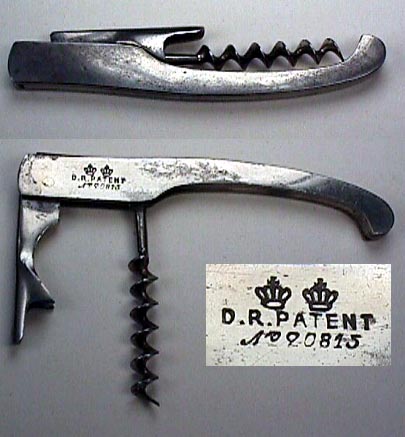
Karl Wienke's original
patented waiters' friend
Actually the waiters' friend is a specific type of corkscrew, designed with a folding body mechanism similar to a pocket knife. It was conceived by German Karl Wienke in 1882 and patented in Germany, England and America.

There have been many embelishments to the original but the basic shape remains the same. And to this day it is the best way of removing any cork from a bottle. Why anyone would want to spend £140 (US$215) on a Le Creuset Wine Accessories LM-G10 Geo Lever Corkscrew just to do exactly the same job I have no idea.

The idea of opening a bottle of wine as a spotty, wet behind the ears youth of 18 when I started in the trade was utterly terrifying. And I find that that continues today with the 18 year olds I employ. Second only to the fear of opening a bottle of Champagne but we will leave that to another day.


10 years old and still works perfectly.
My home waiters' friend from Vinopolis in London
with 'wineman' my lego mascot
Having worked in the trade over 20 years I have used and lost many a waiters friend and even today I cannot put my hand on my current one. It is probably in my draw at work. But the one I have at home was purchased from Vinopolis, the wine museum in London, over 10 years ago and has done sterling service and shows no sign of wear. But how long I will actually continue to need it for is anyones guess.

The problem with cork is that it's a natural product and therefore is prone to shrinkage, allowing oxidation of the wine and is also the main cause of cork taint. The chemistry here is quite complex so I will leave that to wikipedia but the problem of cork taint has been taxing winemakers for over 60 years. The percentage of wine affected depends on which latest study you read. It is generally agreed to be around 6-8% of bottles although other studies have it as less. A major problem no matter who you believe.

The solution to this has been the screwcap or Stelvin Closure. I love that term. If I ever get a band together I think that would be its name. And now topping the bill The Stelvin Closure. Sorry, day dreaming there for a moment. It was developed in the 1960s by French company La Bouchage Mechanique and first used commercially in Switzerland in 1972, the year of my birth. Australian winemakers soon adopted them but the general public were not so keen and even 30 years later some wine lovers dismiss wine with screwcaps as cheap. But this is a dying breed.

In recent times most, even French, winemakers have embraced the screwcap.For example in 2001 1% of New Zealand wines were in screwcap but by 2004 that was 70%. And for me, besides France, New Zealand makes the best wine in the world. Stelvin isn't completely faultless though, as it is estimated that 1 in 50,000 bottles can be affected by reduction which is the opposite of oxidation. So you still need to do a taste test at the table with your guests in a restaurant setting.

So is the end nigh for natural cork. Well not for a good while yet. Almost 69% of the world wine is still in cork although this is reducing rapidly. Also the top producers of some of the great French wines of Bordeaux and Burgundy are yet to be convinced of the ageing potential of a screwcap and are still to change. But I suspect this is only a matter of time.

So how to enjoy the corkscrew or waiters' friend whilst it is still around. Perhaps a visit to the The Corkscrew Inn in Vancouver, Canada which celebrates every facet of the humble cork extractor. Or if that's too difficult at least visit the Virtual Corkscrew Museum. Honestly it's fun!


Next time: My local vineyard. Yes, in Wolverhampton!

Enjoy your wine. Cheers!

Simon
Follow me on twitter