Showing posts with label Wine. Show all posts

Tuesday, 15 September 2015

Content in Kent - The Garden of England Day 2 (of 3)

Day two of my trip to south east England saw me visit four vineyards and ended with an apple crumble. All will become clear.

I started the day with an appointment to meet Sheryl, Sales Executive of Hush Heath Estate at 10.30am. Of all the vineyards I contacted to visit Sheryl was the only one to phone me directly to confirm an appointment, for which I thank you. Looking at the website I was sure I was it would be an enjoyable morning and so it proved. For a start, it was the only time during my three days in the south where the rain stopped for long enough for me to enjoy a walk in the vines.

The journey from Rye took around 40 minutes and found me fairly deeply in the Kent countryside, a few miles from Staplehurst. I say this now, having looked at a map. As with most people these days I was relying entirely on my sat-nav and when this deposited me on a typical country lane with no sign of a winery. No matter the winery was just a few hundred yards further down the road.

I was bang on time for my appointment but took the opportunity to snap a few pictures in the car park. The reception area at Hush Heath is a joy. Beautifully appointed with all of their products, including still wines, sparkling wines, cider and juices neatly displayed along with a variety of branded goodies to promote the Hush Heath name.
Arriving at the fabulous Hush Heath Estate

Cheryl was waiting to meet me. She inquired of my available time and when I said I had an hour offered to take me out in her car to see the vines. I should explain that the vines are some distance from the winery. If you visit be aware that the walking tour of the vines can take around 90 minutes (At other vineyards it will be much shorter) and dogs and buggies are not permitted.

In my journey around the estate we passed by the gorgeous Hush Heath Manor. Built in 1503 it was in some disrepair when purchased by the Balfour-Lynn family in the 1980s. Today it is the gorgeous flagship of a stunning estate producing sensational wines, cider and apple juices. I understand it was Richard, head of the family, that wished to produce the best sparkling wine possible, especially rosé, and boy have they achieved that.

My tour complete I had a full tasting of the full range of Hush Heath produce. For me two products were outstanding; the Balfour Brut Rosé 2010, a hauntingly beautiful sparkler that really is one of the best English Sparkling rosé's around and has the awards to prove it. Sparkling red wines tend to be an Australian specialty but the Balfour 1503 Sparkling Pinot Noir surpasses the ones's that I have tried. For some sparkling red is an acquired taste but I love it. A bottle of each was purchased and a big thank you to Cheryl for taking time to show me around the estate.

I cannot leave Hush Heath without mentioning my meeting with Cathy and Stefan in the vineyards. This husband and wife team are the second generation to work on this land and their passion for the vines really showed. Cathy spoke with such knowledge and understanding of viticulture it is no wonder the wines are so sensational. The vines and orchards are in good and safe hands. I even persuaded them to pose together for a photo for me which Cheryl explained was a real rarity. I have already emailed it over but here it is again.
Cathy and Stefan from Hush Heath
 On leaving Hush Heath I just about had an enough time for a panini for lunch at Kino in Hawkhurst before hurrying to meet Ben at the Oxney Organic Estate. I think it would be fair to say that we are talking about potential for this vineyard. A large estate with recently planted vines (2012) that have only produced one vintage of still rosé wine (2014) so far.

The 850 acres of the estate comprises much farmland, woodlands as well as the vineyards. Organic methods are used throughout and the vineyard is the fourth largest organic vineyard in England. On my arrival the rain had started hammering down again so Ben and myself spent time chatting in the very neat and tidy winery. It has been build by converting an old oasthouse, which are all over Kent, and was built with small vessels to allow for experimenting with small batches of grapes. Too early to say much more at this stage but definitely a winery to watch for the future. A big thank you to Ben for coming in out the rain to show me around and to owner Kristin Syltevik for allowing me to visit.

Ben in the winery of Oxney Organic Estate


In the afternoon I made two further visits to vineyards, which to be honest were rather disappointing. Sedlescombe Organic Vineyard seems to be slightly rebellious as it has no association with the English Wine Producers, the body that most vineyards belong too. I hadn't organised an appointment but noticed it on my route. Owner Roy Cook styles himself the godfather of organic viticulture has been making wine here for over 30 years and I happy to acknowledge pioneers. But.....

The tasting room was rather ramshackle and dated. I was invited to conduct a tasting of their wines for £5. They are currently trumpeting an award for the Sedlescombe 2011 Regent, the first international recognition for an English red wine. They are also happy to declare it England's most expensive red wine at £49.50 a bottle. WHAT? I hear you cry. Yeah, I know I thought it too. And frankly it's not even that great. Sorry, I can only say what I think. No-one in their right mind would pay such a price for this wine. The international award was an obscure one, which garnered much publicity at the time, which is great but there are many better vineyards around. The other wines I tasted were okay but nothing special. I would have left disappointed but for the fact that I got a great photo of Sonia and Pauline who were also enjoying a tasting.
Sonia and Pauline - Cheers ladies!
If Sedlescombe was a disappointment then Carr Taylor Vineyards was even more so. The winemaking here dates from 1971. On my arrival the rain was now hosing down in biblical proportions. A walk around the vines was out of the question.

I ventured inside the tasting area which was tired and dated. The walls have some pictures of David Carr pouring sparkling wine near the Arc de Triomphe with Frenchman looking on in shock and awe. They date from the mid 1980s, possibly earlier. The style of the labels probably also date from that era. All of their wines are made from German cross varieties, popular in the early days of English wine making. No attempt to grow the three noble Champagne varieties has been started.

One of the white wines is called Cannonball. No, really it is. I felt so sad because this vineyard was once clearly cutting edge. I had a cursory tasting of the bland, boring wines and left immediately, having stayed less than 5 minutes. As I left a family of Chinese origin came in. I really wanted to shout "go somewhere else, this isn't English wine anymore"

I really hate having to be critical because I love English wine and want it to go from strength to strength but these two vineyards left me as sad as the inglorious English weather we were getting. I made a brief visit to Hastings which was horrible in the rain, but at least I finally got a new coat to protect me from that rain.

Fortunately I would be perked up the next morning when I met an owner of a vineyard. Meeting Graham Barbour of Woodchurch Wine was fantastic and I will tell you all about it my next blog (part 3).

I mentioned at the start, if you can remember that far back, about the ending with apple crumble. That ending was a few days later when the three glorious Bramley apples that I was given at Hush Heath were baked. And absolutely delicious it was too though I'd still much rather be drinking the fabulous rosé fizz from the estate.

See you next time. In the meantime enjoy your wine. Details of my wine tasting events business can be found at www.gloryofwine.com.
Cheers!

Simon

Friday, 30 January 2015

Picpoul

Or Picpoul de Pinet to be precise. Never heard of it. Well I think you are in for a bit of a treat. Don't misunderstand me it's not going to blow your socks off or anything but if you are looking for an easy drinking white wine that is great as an aperitif and will pair with just about anything then keep your eye open for a bottle of one of southern France's best kept secrets (although not so secret anymore).

When I completed my wine qualifications (10 years since) I don't think it was even mentioned once on the course. I had vaguely heard the name but was sitting in a Café Rouge in Manchester sometime

My first acquaintance with Picpoul
in 2011 and noticed it on their wine list and also that they sold it by the glass. Intrigued I ordered a glass and was hooked immediately. Subsequently I have seen its presence grow exponentially in the last couple of years.

Tesco Finest


All of the main supermarkets have one on their shelves. My personal favourite, and if you follow me regularly you will have seen me recommend it previously, is the Tesco Finest Picpoul which is currently £7.99 but I have seen as low as £5.99.

Produced by Jean Luc Lavergne it is without doubt one of Tesco's best wines and this is confirmed by the high rating it has from Tesco shoppers.


What's The Story?

picpoul
Picpoul de Pinet and surrounding appellations
Pinet is a tiny appellation in the deep south of the Languedoc-Rousillon region of France
between the cities of Montpellier and Béziers. Picpoul is the white grape variety that traditionally used in the production of local vermouth Noilly Prat. As its sales declined more and more of the grapes were diverted to the production of Picpoul de Pinet which led to it's arrival in the UK and growing popularity. Grape production continues to rise.
A sign of quality
As with most regional French wines the history is long and the distinctive 'fire brand' sign, seen on all bottles, was used on barrels from 1773 after permission was granted by Turgot, a future minister of Louis XVI. It comes in a very distinctive tall bottle too which makes it stand out from the crowd.

The actual name Picpoul translates as 'lip stinger' suggesting the wine is high in acidity. I find it utterly refreshing, and not dissimilar to the once mighty but now being quietly (sadly) forgotten gem from the Loire, Muscadet. As with Muscadet it is great with seafood and with shellfish superb. If you're fed up with Sauvignon and good Chablis is rather expensive give this a go. I promise you cannot go wrong.

Picpoul
Magnum and 75cl Picpoul
I had been thinking of writing a blog about Picpoul for a little while. I was convinced yesterday by a
trip to my local Majestic. Picpoul by the magnum. If Majestic feel they can justify selling it by the magnum then it must be popular. I had to buy one (£19.99). On checking it is not available in all stores so you may need to check locally.

I think it will need to sit in my store (with care) until the summer for the right occasion to bring it out but what a bottle to own. If you see me at any local shows with my Glory of Wine Tastings business after the summer I will definitely have it on show (empty though, sorry!).

The Final Word

It's been a little while since I've been in Café Rouge so I thought I would check and yes of only seven wines they serve by the glass the Picpoul, the 'Duc de Morny' still makes the cut. Try it first then please do spread the word.

Do you enjoy my wine blogs? Come and meet me in person. Visit my website www.gloryofwine.com or follow my Facebook or Twitter feeds. I would love to organise a tasting event for you.


Until next time. Enjoy your wine.
Cheers!
Simon


Thursday, 15 January 2015

Matsu

Matsu is a wine producer from the Toro region of Spain that I really like and the styling of their bottles is so unique that I think they are worthy of an individual blog. Did I mention the gorgeous, silky wines? They have been a massive hit in our family, in particular with my sister-in-law Helen.

I say I like them but a higher authority than me Neal Martin, taster for Spain for Robert Parker, rates the El Viejo at 94 points on the 100 point scale. A sensational score for a wine that can be found for less than £25 a bottle. But in fact the whole range is superb.

I first came across the Matsu El Picaro when searching for wine for an early tasting event for my Glory of Wine Tasting business. The event was actually a hen party for Clare and took place at a rented cottage in Staffordshire.

Matsu El Picaro
Great for a hen party!
Matsu El Recio
Great for a party!
On seeing the bottle you may guess why I chose it for the tasting. I figured the handsome chap on the bottle would be a hit with the girls and so it proved with some of them having their photo taken with faces next to the bottle. It was also their favourites wine of the eight we tasted and I thought it pretty good too.


Clare's hen party - The handsome chap is the Matsu El Picaro -
Oh and I am there also holding the bottle!
I went away rather pleased with myself and thought no more about it until looking for wines for another event a few months later where the aforementioned Helen would be a guest at Nathalie's wine party. Knowing they both liked Rioja I was looking for an appropriate Spanish wine when I came across the El Recio. This time the wine was a massive hit with everyone loving it and I think it is without doubt currently one of my favourite wines.
Nathalie's party with Helen (in white) holding the El Recio


Matsu El Viejo
Just great!


By this stage the whole Matsu range was becoming something of a cult in our family and we completed the set with a tasting of the amazing El Viejo a few months later. The bottle labels are used in a very clever and innovative way to show you the age of the vines and the faces used are vineyard workers from the Matsu vineyards.

Roughly translated El Picaro means 'the rogue' or cheeky one (vines 90 years old), El Recio 'the tough one' (90-100 years) and El Viejo 'the old one' (vines 100+ years old) . If I was to pick a favourite it would be the El Recio which is velvety and smooth with plenty of black fruit punchiness and a long, lingering finish. Perfect with some duck, lamb or beef or even some heavier flavoured cheeses.

The fabulous Matsu range


Of course these wines aren't actually Rioja but they are made from the Rioja grape Tempranillo, known as Tinto de Toro here, which makes many great wines all over Spain not just in Rioja.

For more information about Matsu do take a look at their excellent website. Sadly, for the moment Majestic where I purchased all of the above mentioned wines are not currently stocking the Matsu range. If you would like to try some and I highly recommend them you can try Sandhams Wine. I have emailed Majestic to ask if they will be stocking it again and I will post a response on here when I get one.

EDIT - Majestic have confirmed to me today that they should be available again in all stores by the end of February.

Do you enjoy my wine blogs? Come and meet me in person. Visit my website www.gloryofwine.com or follow my Facebook or Twitter feeds. I would love to organise a tasting event for you.


Until next time. Enjoy your wine.
Cheers!

Simon

Monday, 27 October 2014

Crémant

Not sure what it is? Well this blog is here to explain and hopefully encourage you to go out and try some for yourself.
Crémant - Classy bubbles from France
without the expensive price tag

Once upon a time in the UK we had Champagne. Well, we didn't have it as such but we imported quite a lot of it (we still do) and from the late 1800s on enjoyed it at special occasions as a drink of celebration.. The history and story of Champagne is long and you can read a huge number of books devoted to the subject if you so wish so I don't want to dwell on it too much here.

Seeing the success and popularity of Champagne winemakers in other parts of the world began to make their own versions of fizz including Cava from Spain, Sekt from Germany and more recently sparklers from Australia, New Zealand, South Africa, California in the USA, and right here at home in blighty (England to anyone not sure).

One name I have missed out of this is Prosecco from Italy. Prosecco is actually made using the 'tank method' (sometimes called Charmat method) where the secondary fermentation, that creates the bubbles, takes place in a tank rather than in the bottle. It has become very popular with supermarkets and wine merchants reporting massive double figure percentage increases in sales over the last few years.

But whilst we have all these sparkling wines from other countries, until very recently we had rarely seen another form of sparkling wine from France made in exactly the same way as Champagne but offering great value for money.

The literal translation of Crémant is 'creamy', the thought being that these wines give you a creamy mouthfeel rather than fizzy. And I think they are going to be become ever more popular, in fact I am sure of it. The rise of Crémant was first reported in the Telegraph by Henry Samuel back in 2010 but the trend continues and with Aldi and Lidl currently giving the big four supermarkets a run for their money their promotion of excellent value Crémants can only lead to a raising of the profile of such sparklers and therefore increased sales. That and this blog of course!

Crémants are available from eight
designated regions
Crémants are made using the 'traditional method' or 'Méthode Champenoise' which as the name suggests is the same as Champagne. There are eight different designated regions for production Crémants d'Alsace, de Bordeaux, de Bourgogne, de Die, du Jura, de Limoux, de Loire and added just this year de Savoie, each with it's own strict guidelines for production as is the French way.

In some regions the same grape varieties are the same as Champagne, namely Pinot Noir and Chardonnay but other varieties are also used in certain areas such as Chenin Blanc in the Loire and Pinot Blanc and Riesling in Alsace amongst others. Production is not huge particular compared with Champagne. The biggest producing region is Alsace at about 30 million bottles a year, about one tenth that of Champagne. However
Crémant d'Alsace is the most widely purchased non Champagne sparkling wine in France.

But the important point is that is really rather nice and I for one, would rather drink it than Prosecco if the budget doesn't stretch to a bottle of Champagne or English Sparkling.

Now I know many people are taking to Lidl and Aldi to do your shopping, I am too, so next time you're in Lidl pick up a bottle of  Weiber Crémant d'Alsace at just £7.99 a bottle or in Aldi Pierre Bonnet Crémant de Loire at an even bigger bargain £6.79 a bottle. I promise, you won't regret it.

Do you enjoy my wine blogs? Come and meet me in person. Visit my website www.gloryofwine.com or follow my Facebook or Twitter feeds. I would love to organise a tasting event for you.


Until next time. Enjoy your wine.
Cheers!

Simon


Thursday, 11 September 2014

Château Monconseil-Gazin

Following on from my last blog about the Côtes de Bourg this time I will be taking a more in depth look at an individual winemaker from the nearby Côtes de Blaye. Château Monconseil Gazin is owned by Jean-Michel Baudet and his wife Francoise. Jean-Michel is the 5th generation of his family making wine at the Château.

I should say there is a little bit of self interest here. My parents-in-law Rob and Norma, who are big wine lovers, have been enjoying wine from the Monconseil Gazin estate for some years. Their original knowledge of this particular vineyard came about via an unusual present that Norma bought Rob for a birthday.  The birthday presented entitled Rob to own a row of vines for a year at the estate. Mainly a bit of a fun yes, but it has led to them returning to the vineyard and buying the wines every year since.


3D Wines offers an alternative way to
support local vineyards
The gift came from 3D Wines Experience, a well established company offering an opportunity for anyone to support small, family run vineyards. The business was started in 1992 and now offers opportunities to support vineyards in many wine producing areas including most of the main regions of France including Bordeaux, and also vineyards in Tuscany and New Zealand. I believe the opportunity to 'own' vines for a year may have been discontinued but the business is still successful. And it must be working for Château Monconseil Gazin as they are still in the scheme. 

As with the Côtes de Bourg the Côtes de Blaye is one of the lesser known appellations of Bordeaux producing more simple wines but still with 6600 hectares under vine. Merlot is king, with some Cabernet Sauvignon and Malbec also produced. Most wines produced here are blends of the three. The majority of the operations are family affairs and I saw this at first hand on my visit to the Château Monconseil Gazin in July. It was built in around 1500 and soon became an important country seat. Since 1894 five generations of the Baudet family have been making wine although wine has been produced here for many more centuries. It was only in the 1950s that the Gazin parcel of land was added and the Château took the name it is known by today.  The family are celebrating 120 years of history over the weekend of the 20th and 21st September this year.

Touring the cellars
5 fantastic wines are made at Monconseil Gazin
Francoise discussing wines with Rob, Norma & myself
Our visit was unscheduled which was a bit naughty of us (They would prefer you to ring or email ahead if you wish to visit) but Rob and Norma know Francoise so well that there was no problem and soon we were touring the winery and tasting the wines. Five wines are made on the estate and we tried them all. A classic red (Francoise refers to this as the Saturday wine), a grand reserve red (the Sunday wine), a classic white (100% Sauvignon Blanc), a prestige white (Sauv Blanc with 20% Semillon) and finally a rather delicious Rosé that I immediately purchased a case of to bring home. I should add that all the wines were fab and I could have happily drunk the 'Sunday' red every day of the week.
But more important than the details of the wines, Francoise was a fantastic host, speaking perfect English and welcoming us with bundles of enthusiasm for her wines. This is the lovely thing about the wine industry in France. Yes, some of it is very corporate and big business like but much of it isn't. It's about families who are so proud of their produce and they just enjoy sharing that love with you.
As we were leaving we popped our heads into the winery itself and saw Francoise's daughter helping to label the bottles. Francoise  told us she was more interested in horses than wine at the moment but hopefully that will change. I hope so too. So lovely to see a family business being handed from generation to generation. 
If you are ever in France, or indeed in any other wine producing area do go and visit the local vineyard. I am pretty certain you will get a very warm welcome. 

Me with Francoise 


A memento of our visit


Do you enjoy my wine blogs? Come and meet me in person. Visit my website www.gloryofwine.com or follow my Facebook or Twitter feeds. I would love to organise a tasting event for you.


Until next time. Enjoy your wine.
Cheers!

Simon


Friday, 29 August 2014

Côtes de Bourg

Have you heard of the Côtes de Bourg? Well of course you should have if you read my previous blog! Joking aside unless you are a Bordeaux wine aficionado or have maybe visited the area I doubt it. In fact the Côtes de Bourg is one of the 54 appellations of Bordeaux and possibly one of it's least well known.

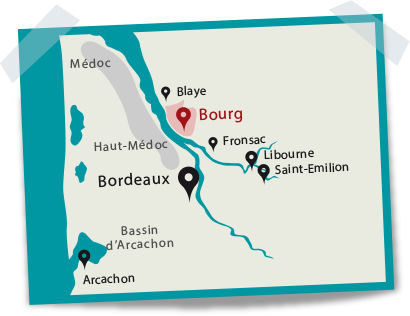
It is situated 35 km (22 miles) to the north of Bordeaux on the 'right bank'. In this case right bank means to the east of the Gironde estuary, whereas 'left bank' means to the west. This is actually an important distinction because due to the soil and climate, or 'terroir' as the French like to call it the 'right bank' tends to be Merlot dominated and the 'left' Cabernet Sauvignon.

Trans-Gironde ferry to the Medoc
I holidayed in the area in July and was absolutely fascinated by the wine production there and it's neighbouring appellation the Côtes de Blaye. This area is certainly not one of the glamour parts of the region like the Haut-Medoc or St Emilion. More a workaday region producing wines mostly drunk locally and by the tourists that pass by. The towns of Blaye and Bourg are lovely places to stay and if you want to go and visit the more prestigious wine places St Emilion is just over an hour away by car (We did) and the Haut-Medoc even closer if you catch the Trans-Gironde ferry (We also did) which departs right from the centre of Blaye.

The Côtes de Bourg styles itself 'The Spicy Side of Bordeaux'. Not entirely sure how true that is, after all we are talking mostly Merlot here not spicy Syrah. However the wines do have a slightly more tannic bite.

But it is the scale of production that I want to get across to you. When driving around the area the vineyards seem to go for mile after mile after mile (sorry kilometer, we are in France after all). The total area under vine is just under 4000 hectares producing. The famous Napa Valley of California has only 17,000 hectares of vines and Marlborough in New Zealand 22,000. Not that small then for a region you've never heard of and the wines virtually never come to the UK or much beyond French borders. 85% is sold in France.

Mere statistics do not tell the whole story though. Wine is such a way of life in France that when visiting a wine producing area you cannot escape the seductiveness of it. We visited the small town of Bourg, took lunch, and then visited the Maison du Vin. Most towns in the area have these. These, literally, 'houses of wine' showcase all of the local wines and very often beautifully presented.

 And finally we come to the best thing of all, the wines are so reasonable to buy. Of 134 wines available 91 were under €10 (£8 or $13) many around €6. And remember these 134 wines come from an area that is small outpost of the whole Bordeaux wine spectrum.

Maison du Vin - Bourg


 The following photos were all taken inside the 'Maison du Vin- Bourg'


As you can see from the photographs the Maison was beautiful inside and a pleasure just to wander around admiring the bottles. I should say it was also nice and cool inside on a scorching hot day! More information about the Côtes de Bourg can be found at the tourism website www.cotes-de-bourg.com.

Next time I shall be recalling my visit to the Chateau Monconseil-Gazin vineyard in the nearby Côtes de Blaye.

Do you enjoy my wine blogs? Come and meet me in person. Visit my website www.gloryofwine.com or follow my Facebook or Twitter feeds. I would love to organise a tasting event for you.

Until next time. Enjoy your wine.
Cheers!
Simon


Friday, 8 August 2014

Bordeaux

I know what you're thinking. Well actually possibly two things. Either, Bordeaux, French wine, Claret, wine of boring old farts and rich bankers or possibly Bordeaux, blimey, big topic for one blog.
Bordeaux - Beautiful city
And home to the greatest wine region in the world


Well, it certainly is a big topic, one that has had thousands of books written about it and I could not possibly do it justice in one of my short blogs. As you may be aware I visited Bordeaux for a holiday last month and this is intended as the first of a series of blog on my time in the region.

Bigger isn't always better - New Zealand wine sales have soared
Bordeaux as a wine producing region is vast, so vast in fact that the amount of wine produced here would rank 10th in the world if Bordeaux was as a country. It produces 675 million litres of wine a year (That is 900 million bottles!). That is 3 times the amount that New Zealand produces.

The comparison with New Zealand is rather apt because 'Kiwi' wine has become very popular in Britain just as sales of French wine have declined in recent years. According to latest Nielsen data 1 in every 5 bottles over £7 is from New Zealand. 


But it wasn't always like that. Bordeaux and England have a long association going back to the 12th century when Eleanor of Aquitaine married Henry Plantagenet, the future King Henry II. Bordeaux was in the control of the British for almost 300 years and it was during the time of Richard the Lionheart, son of Henry and Eleanor that drinking the wines of Bordeaux really took off. Between the end of the Hundred Years War in 1453 and the First World War (1914-1918) Bordeaux boomed and much of the wine was exported to Britain as well as the low countries. The Dutch had a major influence as its engineers drained the marshy and swampy Medoc left bank home of the most famous wine names of the region today.

The classification of the wines was started in 1855. You will often hear me refer to '1855 and all that...' It's a flippant remark and the subject actually deserves a blog all on it's own. Typing 1855 classification into Google gets you over 12 million results. It's actually one of the first things you learn about at wine school, Bordeaux usually being the first region to be covered.

The classification of AOCs (often ACs) or Appellation d'Origine Controlée started in the 1930s and
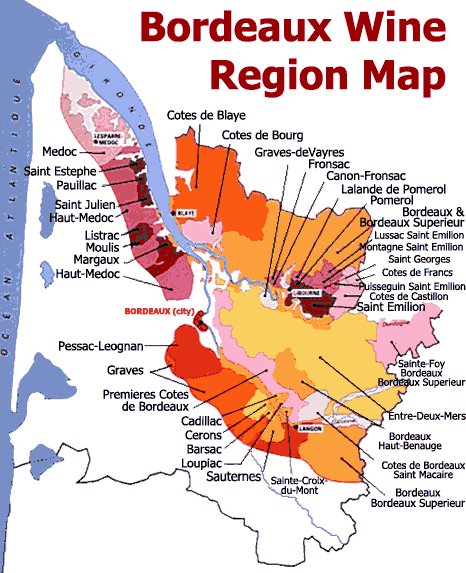
Bordeaux wine map - All 54 appellations of it
continues to be occasionally modified today. The literal translation is 'controlled designation of origin' and it ensures that to be labelled with a particular are the wine must be made in a certain way with regard to the grape types, maturation period and type of maturation for example.

These stiff rules have become restrictive to the winemakers leading to wine from the new world such as Australia, Chile and the aforementioned New Zealand where there are less restrictions on experimentation becoming popular at the expense of classic Bordeaux 'Claret'.

Just the phrase 'Claret' itself is a British invention. It derives from the French word 'clairet' meaning dark rosé which was the typical style of wine exported to Britain during the 12th - 15th centuries. It is a protected word but I prefer not to use it and you will never see it used on a label.

What you will see is a bewildering array of information including the appellation the wine is from, (See the map opposite) but never the actual grape variety which I am sure is one of the principal reasons why the new world has usurped France and Bordeaux in sales.

I spent most of my week in on holiday in the Cotes de Blaye and Cotes de Bourg. I would guess most of you reading this will not of heard of those areas. It is true that they are not the most well known of the Bordeaux appellations but to actual see the rolling vineyards going on for mile after mile is an awe inspiring sight. In my next blog I will tell you a little more about the Cotes de Bourg.

Enjoying the blog. Why not meet me in person. Visit my website www.gloryofwine.com or follow my Facebook or twitter feeds. I would love to organise a tasting event for you.

Until next time, enjoy your wine.
Cheers!
Simon

Tuesday, 10 June 2014

The Judgement of Paris

Never heard of it. No, me neither until relatively recently. Is it a book, a film or a major political happening in France? It's none of those, well actually that is not strictly true as it is a film and a book (written after the event), but a film of a different name.

The Judgement of Paris - May 1976
It is one of the most important happenings in the modern world of wine. On the 24th May 1976 wine merchant, now Consultant Editor of Decanter magazine, Steven Spurrier, organised in Paris, a blind tasting where French judges scored the best and most prestigious Bordeaux red wines and Burgundy Chardonnay against Cabernet Sauvignons and Chardonnays from California.

Steven Spurrier (centre) in 1976 
Steven Spurrier - Today
The results stunned the judges and sent a seismic shock through the wine world and can be seen as year zero in terms of new world regions competing with the traditional old wine regions, in particularly the classic French regions.


Prior to that time the French had the monopoly on 'fine' wines and that reputation went around the world. Serious wine drinkers drank Bordeaux or Claret, as we British used to call it, and Burgundy.To take advantage of the USA's bicentennial celebrations Spurrier, then only 34 and running a wine school in Paris, decided to organise a blind tasting with the great and the good of the French wine world to do the judging. To this day, he thinks that he had rigged it for the French to win. But they didn't and the wine world changed forever.

Chateau Montelena 1973 - 1st place Chardonnay
The eleven judges, nine of them French plus Spurrier and Patricia Gallagher (American) of L'Acadamie de Vin tasted the whites first, four Burgundies and six Chardonnay from California. The judges scored the wines out of 20 and the scores were averaged. Amazingly California wines occupied four of the top 6 places including the prestigious 1st place going to the Chateau Montelena.

1.Chateau Montelena 1973   USA
2.Meursault Charmes Roulot 1973  France
3.Chalone Vineyard 1974  USA
4.Spring Mountain Vineyard 1973  USA
5.Beaune Clos des Mouches Joseph Drouhin 1973  France
6.Freemark Abbey Winery 1972  USA
7.Batard-Montrachet Ramonet-Prudhon 1973  France
8.Puligny-Montrachet Les Pucelles Domaine Leflaive 1972  France
9.Veedercrest Vineyards 1972  USA
10.David Bruce Winery 1973  USA

Stag's Leap 1973 - 1st place red
After the whites came the all important reds, seen as more important. Spurrier knew that Chateau Montelena had won the white tasting and was so desperate for the French to win on the reds he even told the judges so they could mark accordingly. Four Grand Cru Bordeaux against six Californian Cabernets. Despite blatant marking down of the wines that the judges definitely thought were Californian amazingly the USA won again with Stag's Leap Wine Cellars 1973 coming out on top.

1.Stag's Leap Wine Cellars 1973  USA
2.Château Mouton-Rothschild 1970  France
3.Château Montrose 1970  France
4.Château Haut-Brion 1970  France
5.Ridge Vineyards Monte Bello 1971  USA 
6.Château Leoville Las Cases 1971  France
7.Heitz Wine Cellars Martha's Vineyard 1970  USA
8.Clos Du Val Winery 1972  USA
9.Mayacamas Vineyards 1971  USA
10.Freemark Abbey Winery 1969  USA

On hearing the results the French wine industry was horrified and Spurrier was shunned in French wine circles for a time for the damage he had done to their industry. 

The story of the event may not have become so well known had it not been for George Taber, the sole journalist that attended the event who wrote a four paragraph piece for Time magazine. When news of the event reached back to California the effect was electrifying. Where once it made only cheap 'jug' wines now many new people were ready to invest, in particular in Napa Valley which has become the most prestigious of all Californias' wine regions. 

The tourist trade has followed with visits to wineries becoming an important part of the tourism landscape of California. Reruns of 'The Judgement of Paris' have occurred repeatedly since 1976 with the USA wines continuing to win on a regular basis. And the Californian wine industry goes from strength to strength thanks to films like Sideways and the film that tells the story of that day Bottle Shock. 

But I think there is a lesson here for English wines too. Our English Sparkling Wine has done very well in competitions in the last few years, competing very well against Champagnes. What we need next is a momentous event such as 'The Judgement of Paris'. Over the next few years wine tourism in England and Wales is going to become a big but a little booster such as 'The Judgement of Paris' would be very nice indeed.

That is all for now. I will return with another blog soon. Thanks for reading. If you would like to meet me in person and home is in the UK why not book an event with me. More information can be found at my website www.gloryofwine.com. Maybe you need an excuse for a party involving some lovely wines. Or you might like to come to one of my events. Do get in touch.

You can also follow me on twitter or on facebook

 Enjoy your wine. Cheers!

Simon