Showing posts with label australian wine. Show all posts

Tuesday, 28 May 2013

What's in a Name? - New World versus Old

Firstly some housekeeping. I flagged up at the end of my last blog that I would be writing about my local vineyard next. Unfortunately I have not yet had chance to do the tour of the place with the owners and I would like to wait until I have done that before I write about it even though I know it well. Hopefully next time.

On Day 1 at wine school the first thing you learn is about how, historically, winemakers name their wines. Well actually, that is not quite true. The first thing you learn is that white wine is not made from white grapes and red wine is not made from red grapes and that rosé is definitely not made by mixing red wine and white wine together.

What I mean is that old world wines from France, Italy and Spain most prominently name their wines based on place rather than the type of grape variety. This is why we get Rioja, Chianti and Beaujolais instead of Tempranillo, Sangiovese and Gamay. In the new world winemakers make the name of the grape variety pre-eminent so we talk about the Chardonnay of Australia, Chenin Blanc of South Africa or Pinot Noir of New Zealand.

It's not an exact science but it is a good rule of thumb. I say this because there are some new world wine areas that are increasingly synonymous with a particular style of wine. Perhaps the best example these days would be Marlborough 'Sauvignon' from New Zealand.

Australian Burgundy anyone?
In fact if we go back some 25 years plus it was common place for the new world producers to use French names on their bottles so we had Australian Burgundy or Chablis for example. Even in Europe this practice existed to a certain extent. Spanish Cava (which I have to say is a fabulous way to start an evening) was commonly called Spanish Champagne, I suspect primarily to encourage British consumers to buy when in the Costas on the early package holidays of the 1960s and 70s.

Of course this practice no longer exists due to the European Law Protected Geographical Status regulations which protects the status of many local specialties including many British ones including Melton Mowbray Pork Pies and Stilton cheese. See, Europe is not all bad.

For Australian wines the process took a little longer and only on 1st September 2010 did the practice become illegal although in reality Australian winemakers has stopped using French names when their wine became all the rage in the 1980s.

Over the last 20 years in the time that I have worked in the hospitality trade the knowledge of the general public about wine has increased about 100 fold. These days virtually anyone who drinks wine will know what grape varieties they like to drink. And they will ask for wines by grape variety. I am confident that of the many people that come in and ask for a glass of Merlot if I offered them a glass of St Emilion (leaving aside price issues and I do know that a lot of St. Emilion is blended with Cab. Franc and a little Cab. Sauv) many would say 'no thanks just the Merlot please'. And that really is a great shame because the best wine will always be French.

A classic selection of French wines - How many grape varieties can you see named?
With the massive advancement of Australian, Californian and more recently Chilean and New Zealand wines the vast majority of the public know only grape varieties and not the classic regions and I for one am very sad about that and am making it my aim to encourage people to learn more.

One of the common questions I ask my staff, and they always forget, is what grape variety is Chablis? It causes so much confusion and discussion. In fact I am too embarrassed to repeat the answer one of my staff gave to me to this question. But hey, I'll never give up trying to educate. Oh, and of course it is Chardonnay by the way.

If you enjoy what you're reading why not book a wine tasting with me. See my website at www.gloryofwine.com or follow me on twitter.

Until next time thanks for reading and enjoy your wine.

Cheers
Simon


Thursday, 25 April 2013

Tales Of The Old Waiters' Friend

File:Korkenzieher 01 KMJ.jpg
The corkscrew at its simplest
Ah, the waiters' friend. Once the most important piece of kit that any waiter, barman and especially sommelier could have in his pocket. If you're not sure what I mean I'm guessing you have not worked in hospitality. At home you might call it a corkscrew.

Whatever you call it,  for almost 400 years the corkscrew was the way to remove your corks from your wine bottles.


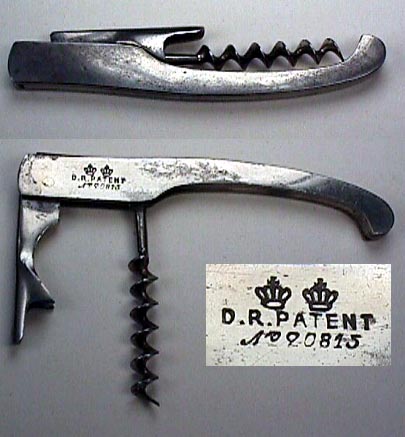
Karl Wienke's original
patented waiters' friend
Actually the waiters' friend is a specific type of corkscrew, designed with a folding body mechanism similar to a pocket knife. It was conceived by German Karl Wienke in 1882 and patented in Germany, England and America.

There have been many embelishments to the original but the basic shape remains the same. And to this day it is the best way of removing any cork from a bottle. Why anyone would want to spend £140 (US$215) on a Le Creuset Wine Accessories LM-G10 Geo Lever Corkscrew just to do exactly the same job I have no idea.

The idea of opening a bottle of wine as a spotty, wet behind the ears youth of 18 when I started in the trade was utterly terrifying. And I find that that continues today with the 18 year olds I employ. Second only to the fear of opening a bottle of Champagne but we will leave that to another day.


10 years old and still works perfectly.
My home waiters' friend from Vinopolis in London
with 'wineman' my lego mascot
Having worked in the trade over 20 years I have used and lost many a waiters friend and even today I cannot put my hand on my current one. It is probably in my draw at work. But the one I have at home was purchased from Vinopolis, the wine museum in London, over 10 years ago and has done sterling service and shows no sign of wear. But how long I will actually continue to need it for is anyones guess.

The problem with cork is that it's a natural product and therefore is prone to shrinkage, allowing oxidation of the wine and is also the main cause of cork taint. The chemistry here is quite complex so I will leave that to wikipedia but the problem of cork taint has been taxing winemakers for over 60 years. The percentage of wine affected depends on which latest study you read. It is generally agreed to be around 6-8% of bottles although other studies have it as less. A major problem no matter who you believe.

The solution to this has been the screwcap or Stelvin Closure. I love that term. If I ever get a band together I think that would be its name. And now topping the bill The Stelvin Closure. Sorry, day dreaming there for a moment. It was developed in the 1960s by French company La Bouchage Mechanique and first used commercially in Switzerland in 1972, the year of my birth. Australian winemakers soon adopted them but the general public were not so keen and even 30 years later some wine lovers dismiss wine with screwcaps as cheap. But this is a dying breed.

In recent times most, even French, winemakers have embraced the screwcap.For example in 2001 1% of New Zealand wines were in screwcap but by 2004 that was 70%. And for me, besides France, New Zealand makes the best wine in the world. Stelvin isn't completely faultless though, as it is estimated that 1 in 50,000 bottles can be affected by reduction which is the opposite of oxidation. So you still need to do a taste test at the table with your guests in a restaurant setting.

So is the end nigh for natural cork. Well not for a good while yet. Almost 69% of the world wine is still in cork although this is reducing rapidly. Also the top producers of some of the great French wines of Bordeaux and Burgundy are yet to be convinced of the ageing potential of a screwcap and are still to change. But I suspect this is only a matter of time.

So how to enjoy the corkscrew or waiters' friend whilst it is still around. Perhaps a visit to the The Corkscrew Inn in Vancouver, Canada which celebrates every facet of the humble cork extractor. Or if that's too difficult at least visit the Virtual Corkscrew Museum. Honestly it's fun!


Next time: My local vineyard. Yes, in Wolverhampton!

Enjoy your wine. Cheers!

Simon
Follow me on twitter


Monday, 25 February 2013

A Visit of Austalia Part 3 - Barton Jones Winery

It's been a few weeks now since we returned from our fantastic trip 'down under' but I did not want to say goodbye to Australia without one further blog about our wine experiences there. Our visit to Barton Jones Wines was without doubt one of the most enjoyable experiences of our holiday and a highlight of our trip to Western Australia's south west and the Margaret River wine region.


The visit came about because owners Adrian Jones and Jackie Barton are good friends, and fellow emigres from the UK, of Richard and Emma (see my previous blog).
Barton Jones Owners Adrian and Jackie with their dog Mitz

We visited early Friday afternoon on our way back to Perth from Busselton, their winery being near the town of Donnybrook a little way from the main wine region. We were met on arrival by their dog Mitz who has featured in the Wine Dogs Australia series. Both myself and Louise, my wife, are quite nervous of dogs but Mitz was on her best behaviour and enjoyed playing with our friends' five year old son Sebastian.

Over the next few hours we were treated to a fantastic BBQ lunch with the most fabulous wines from their estate followed by a tour of the property including the soon to be completed cellar door which they hope to have up and running  by September.


Myself after my first glass of Shilly-Shally
Jackie and Adrian emigrated to Australia over a decade ago, hoping for a better quality of life. Their original careers of IT recruitment (Jackie) and mining engineering (Adrian) gave them that life but they wanted to control their own destiny and so began the hunt for a business venture that would give them self sufficiency. Initial thoughts were of possibly an olive farm until a real estate agent but them on the trail of their current home and business 10 years ago. The business that we see today is a far cry from the run down vineyard they purchased which was originally started in 1978.
During the course of the afternoon we tried a number of the Barton Jones wines. In 2003 the Blackboy Ridge range was begun with an initial production of 50 cases of Semillon. The Blackboy Ridge continues to be produced offering more simple fruit driven wines in a range of grape varieties that can be drunk everyday.


In 2007 the Barton Jones range was introduced with a more premium, wood aged style with potential for cellaring. Each of these wines has it's own 'name' such as 'The Top Drawer' or 'The Bigwig'. Nice touch and it also gives them a personality of their own. I'm not usually a huge fan of Chenin Blanc but I absolutely loved the 'Shilly-Shally'. Lovely zingy freshness but with a creamy finish reminiscent of peach or apricot. It packs a punch at 13% but I could happily sit out on a summers afternoon and drink a fair few glasses.

Adrian and myself examining Semillon vines
The view across the vines towards Donnybrook
 
On the red side I loved the 'The BigWig' Shiraz with its subtle spices and mellow tannins. Again, I'm not always the biggest fan of 100% Shiraz as the spice can be overwhelming for my palate but it says something for Adrian and Jackie that I thoroughly enjoyed two grapes that are not always my favourites. I should also add that Louise, who prefers lighter wines, really loved the Blackboy Ridge wines. After a long, lazy lunch we made our way down the hill to look on progress of their cellar door. The project to open a cellar door has been ongoing since 2009 and all being well will open in September 2013 when Adrian hopes to give up his commute and 4 day working week in Perth to concentrate full time on their wine business. After we were so royally looked after, I'd like to wish them the best of success in their new venture and if you're in the Margaret River region after September take a little detour to Donnybrook to check them out. It will be worth it, I guarantee it!


Next time: Birmingham School of Wine, oh and my father-in-law Rob.

Enjoy your wine. Cheers!

Simon

Follow me on twitter


Monday, 28 January 2013

A Visit of Australia Part 2


Before we start I have a little confession to make. Before we arrived in Perth, I had little knowledge of one of Australia's great wine making regions and where some of the finest wine in the world is made. That is, of course, the Margaret River wine region of Western Australia, an area we were going to be be spending four days.

I mentioned in my last blog that I had always been rather dismissive about Australian wine and for my WSET certificate knowledge of Australia was rather confined to the Hunter Valley in New South Wales and the areas near Adelaide in South Australia. So to 'discover' Margaret River was a bit of a gem.

We were staying in the lovely seaside town of Busselton in the north of the region and travelling in our friends car. They have a young son so getting to a few wineries was going to be difficult but I came across a great idea whilst reading a tourist brochure on our first night in Busselton. A guided tour of the region including 5 wineries, lunch in a brewery and they pick you up and return you to your accommodation. Ace, Louise thought so too so we made the necessary arrangements for two days time.

Gerry and Astuti of Cellar d'Or Winery Tours
Cellar d'Or winery tours is run by Gerry and Astuti Cunningham who we met on the day. They appear to offer the best value tour in the area at AUS$82. I checked them out on Tripadvisor and the feedback was glowing. There are more expensive tours available on which you may see higher profile wineries and perhaps have a more formal lunch but for us they were perfect. I felt relaxed from the second Astuti collected us from our accommodation. We picked up two further couples and made our way to our first winery for our first tasting of the day at around 10.45am!


Yours truly discussing the wines of Mongrel Creek with Shirley
Mongrel Creek is a relatively young winery, having opened in 1996. There slogan is 'No Pretence, No Bullshit'. This marketing angle seemed slightly at odds with the lovely tranquil atmosphere in their beautiful cellar door where we were guided through the wines by Shirley, wife of Larry who own the Vineyard. We started with some fizz, always the best way to start a day, and worked our way through six lovely wines which included a rather delicious sweet red, a style which you hardly ever find in Europe but seems to be something of an Australian speciality. A great start to the day and we came away with a bottle of said sweet red.

Swooping Magpie range of wines
At the next winery we met up with another group meaning that for the rest of the day there would be 13 of us . Swooping Magpie appeared to be a rather larger operation than Mongrel Creek and we were met by owner Neil Tuffield who was clearly very passionate about his wines. With the larger group the atmosphere was busier and there were also some members of the general public in the cellar door. A nice touch was to offer several varieties of cheese and biscuits with the wine and we liked it so much we bought some cheese and biscuits to take home for later along with a rather fine Verdelho, although all the wines were great and I really loved the 'kid on a bike' motif.

Next stop was the Bush Shack Brewery for lunch where we also received a 100ml taster of one of their brews. The lunch consisted of a simple platter of meats, cheeses, pate, bread and salad. Simple, yes but perfect for us and there was more than enough to go round.

Cape Naturaliste, Lovely view shame about the attitude
After lunch we visited the nearby Cape Naturaliste Vineyard in Yallingup and our first poor experience. We were met by Lisa whose presentation style could be most kindly described as 'in yer face'. She started by pouring everyone water and telling us how to taste wine. Now, as someone in the trade this is important, but not so important for tourists out to have a good time. She then told unnecessary stories which included some rather off colour material about lesbianism, I kid you not. Maybe she was just nervous but it did not come across well.
The winery had won quite an auspicious award in London for their Torpedo Rocks Cabernet Sauvignon 2009. Lisa gave us the impression that they were quite nonchalant about entering it, winning it or even collecting the trophy. I noticed they were not quite so nonchalant about charging an eye watering AUS$110 a bottle for said wine with the rest of the wines priced at an also quite pricey AUS$35. A whiff of profiteering filled my nostrils. The general public are a great barometer and when the tasting was over everyone went immediately back to the bus with no one buying anything. This was the only time this happened during the whole day.

Liz and the fabulous House of Cards
Spot on!
The next winery could not have been more different. The House of Cards winery is owned by Travis and Elizabeth Wray and Liz was on hand to guide us through the tasting. The styling of the winery was really beautifully done both with the marketing of their wine and the layout of the Cellar Door. There was lovely cook books, art, jewellery and various ornamental nick nacks to purchase as well as the wine. The wine was also a joy and after trying the full range I purchased a bottle of the 2011 Cabernet Merlot which I have yet to open. It is also the place where I got my favourite photograph of the holiday with me and the Sauvignon Blanc sign. As it's my favourite variety it could not be more appropriate.


The final winery of the day was Fermoy Estate a rather grand winery with considerable pedigree having been opened in 1987 which by Margaret River standards is a long time. I shouldn't say this but I was kind of expecting the same look down your nose attitude that we got at Cape Naturaliste but I'm pleased to say that wasn't the case, indeed the wines we tried were definitely the best of the day. They make quite a big deal about the fact that their wine, the Estate Cabernet Sauvignon was chosen to be served at the Danish Royal Wedding when Australian Mary Donaldson married Crown Prince Frederik in May 2004. We tried the same wine in the 2010 vintage and it was absolutely superb, by far the best wine of the day with soft tannins and lovely chocolate and cherry flavours. A purchase was made.

By this stage we were all tiring, as you probably are reading this, and it was time to say our goodbyes and return to our accommodation but not before Gerry organised a prize draw where one person (sadly neither of us) won, yes you guessed it, a bottle of wine. All in all a fantastic day and something I would recommend to anyone able to visit the fabulous region of Margaret River.

Next time: A visit of Australia Part 3. My personal visit and tour of Barton Jones Wines in Donnybrook, oh and Mitz the dog!

Enjoy your wine. Cheers!

Simon